
Consumer behaviour
Interdisciplinary study of purchase, use, and disposal of goods.

Costalesmarlynjean · CC BY-SA 4.0
Consumer behaviour is the study of individuals, groups, or organisations and all activities associated with the purchase, use and disposal of goods and services. It encompasses how the consumer's emotions, attitudes, and preferences affect buying behaviour, and how external cues—such as visual prompts, auditory signals, or tactile (haptic) feedback—can shape those responses. Consumer behaviour emerged in the 1940–1950s as a distinct sub-discipline of marketing, but has become an interdisciplinary social science that blends elements from psychology, sociology, social anthropology, anthropology, ethnography, ethnology, marketing, and economics (especially behavioural economics).
- field
- Marketing, interdisciplinary social science
- known_for
- Study of purchase, use, and disposal of goods and services; analysis of consumer emotions, attitudes, and preferences
- origins
- 1940s–1950s as a sub-discipline of marketing
- influenced_by
- Psychology, sociology, anthropology, ethnography, economics (behavioural economics)
Lore & Background
Consumer behaviour formally investigates individual qualities such as demographics, personality lifestyles, and behavioural variables (like usage rates, usage occasion, loyalty, brand advocacy, and willingness to provide referrals), in an attempt to understand people's wants and consumption patterns. It also investigates influences on the consumer, from social groups such as family, friends, sports, and reference groups, to society in general (brand-influencers, opinion leaders). Due to the unpredictability of consumer behavior, marketers and researchers use ethnography, consumer neuroscience, and machine learning, along with customer relationship management (CRM) databases, to analyze customer patterns.
In the 1940s and 1950s, marketing was dominated by classical schools of thought that were highly descriptive and relied heavily on case study approaches. At the end of the 1950s, two important reports criticised marketing for its lack of methodological rigor, especially the failure to adopt mathematically-oriented behavioural science research methods. From the 1950s, marketing began to shift its reliance away from economics and towards other disciplines, notably the behavioural sciences, including sociology, anthropology, and clinical psychology. This resulted in a new emphasis on the customer as a unit of analysis, adding such ideas as opinion leadership, reference groups, and brand loyalty.
In its early years, consumer behaviour was heavily influenced by motivation research, which had increased the understanding of customers and had been used extensively by consultants in the advertising industry and within the discipline of psychology in the 1920s, 1930s, and 1940s. By the 1950s, marketing began to adopt techniques used by motivation researchers including depth interviews, projective techniques, thematic apperception tests, and a range of qualitative and quantitative research methods. More recently, scholars have added ethnography, photo-elicitation techniques, and phenomenological interviewing, as well as neuroimaging studies and big data analytics.
Reader's Guide
Consumer behaviour is significant as a distinct sub-discipline of marketing that emerged in the 1940–1950s, transforming marketing from a descriptive, case-study-based field into an interdisciplinary social science. Its legacy lies in shifting the focus from the product to the customer as a unit of analysis, introducing concepts such as opinion leadership, reference groups, and brand loyalty. The field formalised the study of purchase, use, and disposal activities, and the emotional, mental, and behavioural responses that precede or follow them. It also advanced market segmentation, particularly demographic segmentation based on socioeconomic status and household life-cycle. Modern consumer behaviour incorporates ethnography, consumer neuroscience, machine learning, and CRM databases to analyse customer patterns and enable highly targeted marketing strategies. The discipline is now regarded as an important sub-discipline within marketing and is included as a unit of study in almost all undergraduate marketing programs.
Did You Know?
- Consumer behaviour emerged in the 1940–1950s as a distinct sub-discipline of marketing.
- It blends elements from psychology, sociology, social anthropology, anthropology, ethnography, ethnology, marketing, and economics (especially behavioural economics).
- In its early years, consumer behaviour was heavily influenced by motivation research used in the advertising industry and psychology in the 1920s, 1930s, and 1940s.
- Contemporary research incorporates neuroimaging studies and big data analytics to understand subconscious consumer motivations.
From Case Studies to a Rigorous Discipline
Consumer behaviour did not arrive fully formed. In the 1940s and 1950s, marketing was largely descriptive, leaning on case studies and the occasional interview. By the late 1950s, two landmark reports called out the field's methodological weaknesses, particularly its failure to embrace mathematically oriented behavioural science methods. That critique opened the door for marketing to borrow heavily from sociology, anthropology, and clinical psychology, shifting the unit of analysis toward the customer themselves. Concepts like opinion leadership, reference groups, and brand loyalty entered the vocabulary. Demographic segmentation—built on socioeconomic status and household life-cycle—became a standard tool. The discipline also absorbed techniques from motivation research that had been used by advertising consultants and psychologists since the 1920s: depth interviews, projective techniques, and thematic apperception tests. Over time, these were supplemented by ethnography, photo-elicitation, phenomenological interviewing, neuroimaging, and big data analytics. Today, consumer behaviour is a core unit in nearly every undergraduate marketing programme.
The Full Arc of Consumption
Consumer behaviour is far broader than the moment a card is swiped. The field captures every activity linked to the purchase, use, and disposal of goods and services, along with the emotional, mental, and behavioural responses that surround those activities. Purchase activities include information search, evaluation, and payment. Use or consumption activities examine the who, where, when, and how of consumption, the symbolic associations attached to products, and how goods are distributed within a family or consumption unit. Disposal activities cover how consumers rid themselves of products and packaging, and even reselling through platforms like eBay or second-hand markets. The consumer in this framework is not limited to the person who pays; it can be an end user anywhere in the distribution chain, whether an individual or an organisation. The American Marketing Association frames the whole process as a dynamic interaction of affect, cognition, behaviour, and environmental events through which people conduct the exchange aspects of their lives.
The Web of Internal and External Influences
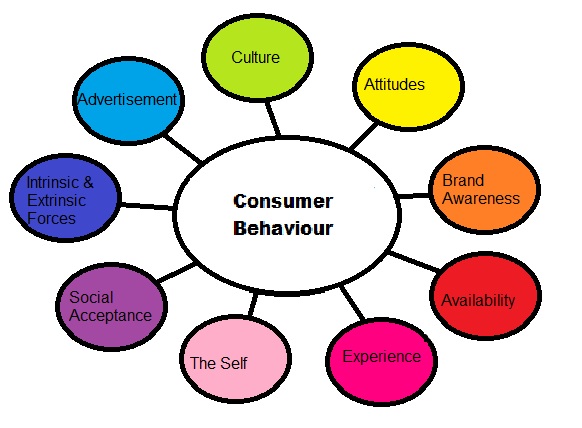
Understanding why people buy, use, and discard what they do requires mapping both internal and external forces. Internally, researchers examine demographics, personality, lifestyle, and a cluster of behavioural variables such as usage rates, usage occasion, loyalty, brand advocacy, and willingness to refer others. Externally, the consumer is embedded in a layered social environment: family, friends, sports communities, reference groups, and broader society, including brand-influencers and opinion leaders. Even the physical environment of a purchase or consumption setting can steer responses through visual prompts, auditory signals, or tactile haptic feedback. Because these interactions are inherently unpredictable, the field treats the consumer as a complex, multi-influenced actor rather than a simple rational calculator. The goal is to build a picture of wants and consumption patterns rich enough to explain not just what someone buys, but why, when, with whom, and under what emotional or social conditions.
Data-Driven Insight and Modern Toolkits
The unpredictability of consumer choices has pushed the field toward ever more sophisticated analytical instruments. Ethnography, consumer neuroscience, and machine learning now sit alongside customer relationship management databases as core methods. The vast transactional and interactional data held in CRM systems allows researchers to dissect factors behind customer loyalty, re-purchase intentions, referral behaviour, and brand advocacy in granular detail. That same data underpins behavioural market segmentation, which in turn feeds highly targeted and personalised marketing strategies. More recently, neuroimaging studies and big data analytics have opened a window into subconscious motivations and decision-making processes that traditional surveys could not reach. These tools complement earlier qualitative methods—depth interviews, projective techniques, photo-elicitation, phenomenological interviewing—creating a layered evidentiary base. The result is a discipline that blends experimental behavioural principles with large-scale pattern recognition, positioning consumer behaviour at the intersection of economic psychology and marketing science as an applied social science.
Gallery

Frequently Asked Questions
What is Consumer behaviour?
It is the study of how individuals, groups, and organisations go about purchasing, using, and eventually discarding goods and services. It also examines the emotional, attitudinal, and preference-based forces that steer those decisions.
What are Consumer behaviour's core 'powers' or scope?
Its reach spans the entire buyer-side product lifecycle—acquisition, consumption, and disposal—and it specifically analyses how sensory cues like visual prompts, sounds, and tactile feedback nudge purchasing choices.
Where did Consumer behaviour come from?
It first crystallised as a distinct sub-discipline within marketing during the 1940s and 1950s. Since then it has grown well beyond marketing into a broader interdisciplinary social science.
Which disciplines feed into Consumer behaviour?
It draws on psychology, sociology, social anthropology, ethnography, and behavioural economics, which is why it is classified as an interdisciplinary field rather than a single-department topic.
Why does Consumer behaviour matter?
It sits at the centre of marketing and consumer research because it explains not merely what people buy, but the emotional and social machinery behind every buying, using, and discarding decision.
More in Economic Concepts & Models 1-24
Elsewhere in the Economic Concepts & Models universe
Spotted an error? Know more?
This is a living reference — every entry is fact-audited, and reader corrections feed straight into our audit queue. Suggest an edit · See this site's audit record