
Competition (economics)
Rivalry among firms to obtain limited goods by varying market elements.

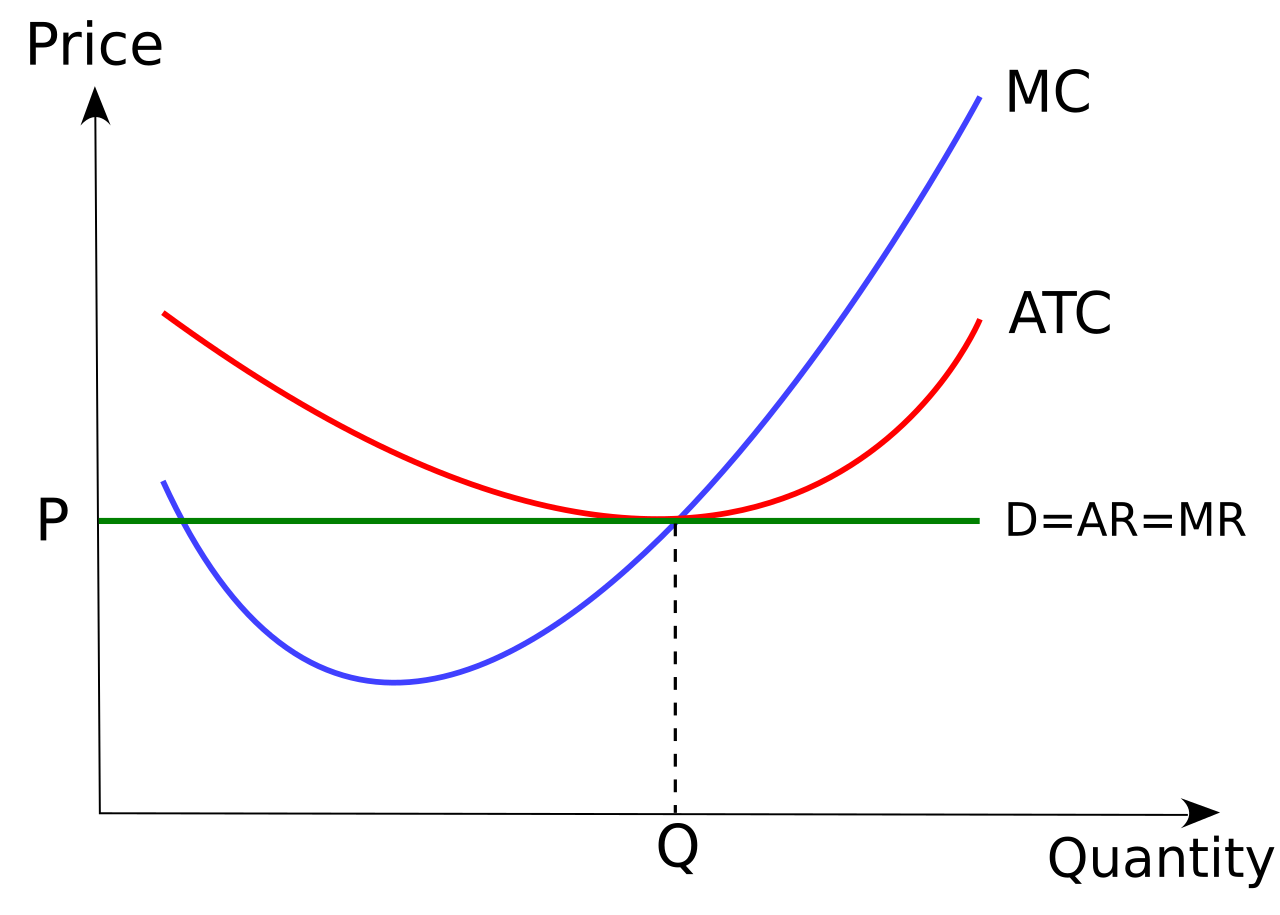
Costcurve_-_Combined.png : The original uploader was Trampled at English Wikiped · CC BY-SA 3.0
Competition in economics is a scenario where different economic firms contend to obtain limited goods by varying elements of the marketing mix: price, product, promotion, and place. It is a central concept in classical and neoclassical economic thought, driving firms to develop new products, services, and technologies, and typically leading to lower prices and greater consumer selection compared to monopoly or oligopoly.
- related_theorist
- Multiple (e.g., Adam Smith, Alfred Marshall)
Lore & Background
The level of competition in a market depends on factors such as the number of firms, barriers to entry, information availability, and resource accessibility. The number of buyers and their willingness to pay also influence overall demand. Competitiveness, derived from the Latin word 'competere', refers to the ability of a firm, sub-sector, or country to sell goods relative to others in the same market, often involving attempts to take market share from rivals.
Reader's Guide
Competition is a foundational concept in economics, shaping market structures from perfect competition to monopoly. In classical thought, it spurs innovation and benefits consumers through lower prices and greater selection. The extent of competition can be measured by the number of rivals, their size similarity, and the market share of the largest firm. Neoclassical theory defines perfect competition as a theoretical ideal rarely observed, characterized by many small firms, identical products, perfect information, and zero long-run economic profit. In contrast, imperfect competition—the realistic market form—includes monopolies, oligopolies, and externalities, where firms can influence prices and earn positive profits. The study of competition informs both microeconomic analysis and broader economic policy, particularly regarding barriers to entry and market efficiency.
Did You Know?
- The word 'competitiveness' derives from the Latin 'competere', referring to rivalry between entities in markets and industries.
- In perfect competition, firms earn zero economic profit in the long run, a condition derived from the work of classical economists like Adam Smith and later formalized by Alfred Marshall, not Antoine Augustin Cournot.
- Natural monopolies can produce and sell at a lower cost to consumers than if competition existed in the market.
- While a low market share for the largest firm can indicate competition, it does not guarantee vigorous competition if other structural factors such as collusion or high barriers to entry are present.
Post-War Origins and the Truman Mandate
Economic development as a formal discipline and policy framework was born in the aftermath of World War II, rooted in the reconstruction efforts championed by the United States. In 1949, President Harry Truman laid out a vision in his inaugural address, declaring that more than half the world's population lived in conditions bordering on misery—suffering from inadequate food, disease, and stagnant economic life. He framed this not merely as a humanitarian concern but as a strategic threat to prosperous regions. Truman called for a program grounded in democratic principles, arguing that the key to prosperity and peace lay in greater production, which in turn depended on the wider application of modern scientific and technical knowledge. This speech effectively set the stage for decades of Western development policy, positioning the transfer of technical expertise to less developed nations as both a moral obligation and a geopolitical priority. The concept had existed in Western thought for centuries, but it was this post-war moment that crystallized it into an actionable policy agenda.
Theoretical Lineages and Key Thinkers
The intellectual architecture of economic development drew from multiple competing traditions. It emerged as an extension of traditional economics, which had focused narrowly on aggregate national product, toward a broader concern with people's entitlements and capabilities—literacy, nourishment, health, and education. The field was shaped by the tension between Keynesian advocacy for government intervention and neoclassical emphasis on reduced state involvement. Economist Albert O. Hirschman contributed foundational models while noting that development discourse increasingly centered on poor regions across Africa, Asia, and Latin America. Alexander Gerschenkron offered a crucial insight: the less developed a country was at the start of its journey, the more likely certain structural conditions would emerge, meaning no two nations followed identical paths. Schumpeter and Backhaus later argued that changes in an economy's equilibrium state could only be triggered by external intervening factors. Meanwhile, Amartya Sen positioned economic growth as merely one facet within the larger process of development, a distinction that would prove central to the field's identity.
Defining the Indefinable
Pinpointing exactly what economic development means has proven remarkably contentious. Twentieth-century economists tended to equate it with economic growth—rising per capita income and expanding GDP—while sociologists pushed for a broader lens encompassing modernization and structural change. Karl Seidman offered a synthesis, describing it as the process of creating and utilizing physical, human, financial, and social assets to generate broadly shared well-being. Daphne Greenwood and Richard Holt sharpened the distinction from mere growth by emphasizing sustainability and the overall standard of living, noting that per capita income figures do not automatically translate into improved quality of life. The United Nations Development Programme, in 1997, reframed development as expanding people's choices, identifying empowerment, equity, productivity, and sustainability as its four pillars. Mansell and Wehn observed that non-specialists had long understood development to mean reaching a standard of living comparable to industrialized nations. These competing definitions reflect a field that has never fully settled on a single operational meaning.
From Industrialization to Poverty: The Shifting Policy Compass
The policy priorities of economic development have undergone dramatic realignments across the decades. From the 1940s through the 1960s, the dominant approach was modernization theory, with states playing a heavy hand in promoting industrialization and building infrastructure in developing nations. The 1970s brought a brief pivot toward basic needs development, emphasizing human capital and redistribution. Then neoliberalism swept through the 1980s, championing free trade and dismantling import substitution industrialization policies. A particularly consequential institutional shift occurred under Robert McNamara's thirteen-year tenure at the World Bank, where he redirected the institution's focus toward targeted poverty reduction. Before his leadership, poverty had received little substantive attention in international development; the emphasis had been squarely on industrialization and infrastructure. Under McNamara's influence, poverty was redefined as a condition experienced by individuals rather than an attribute of entire countries. Asian and European proponents of infrastructure-based development have continued to argue that sustained government investment in transportation, housing, education, and healthcare remains essential for sustainable growth in emerging economies.
Gallery




Frequently Asked Questions
Who is Competition (economics)?
Competition (economics) is the ongoing rivalry between firms as they battle for a share of limited market resources by tweaking their pricing, product offerings, promotional strategies, and distribution channels. It sits at the heart of both classical and neoclassical economic theory.
What are Competition (economics)'s powers/role?
Its main 'abilities' include pushing companies to invent new products, services, and technologies in order to outmaneuver rivals. It also acts as a natural check on pricing, generally keeping costs down and expanding the range of choices available to buyers.
How does Competition (economics)'s story end?
Rather than a single villain being defeated, the arc resolves into a market where consumers enjoy lower prices and a wider variety of options than they would under a monopoly or a small-group oligopoly. The rivalry itself is the lasting 'ending'—a continuous cycle of adaptation.
Why is Competition (economics) important?
It is the engine that forces firms to innovate and stay efficient, making it one of the most foundational ideas in economic thought. Without it, markets tend toward stagnation, higher prices, and fewer choices for the consumer.
Who are the key theorists behind Competition (economics)?
No single author 'created' the concept; it was shaped over centuries by multiple thinkers, most notably Adam Smith and Alfred Marshall, among others. Their collective work laid the groundwork for how we understand firm rivalry in markets today.
More in Economic Concepts & Models 1-24
Elsewhere in the Economic Concepts & Models universe
Spotted an error? Know more?
This is a living reference — every entry is fact-audited, and reader corrections feed straight into our audit queue. Suggest an edit · See this site's audit record