
Compound interest
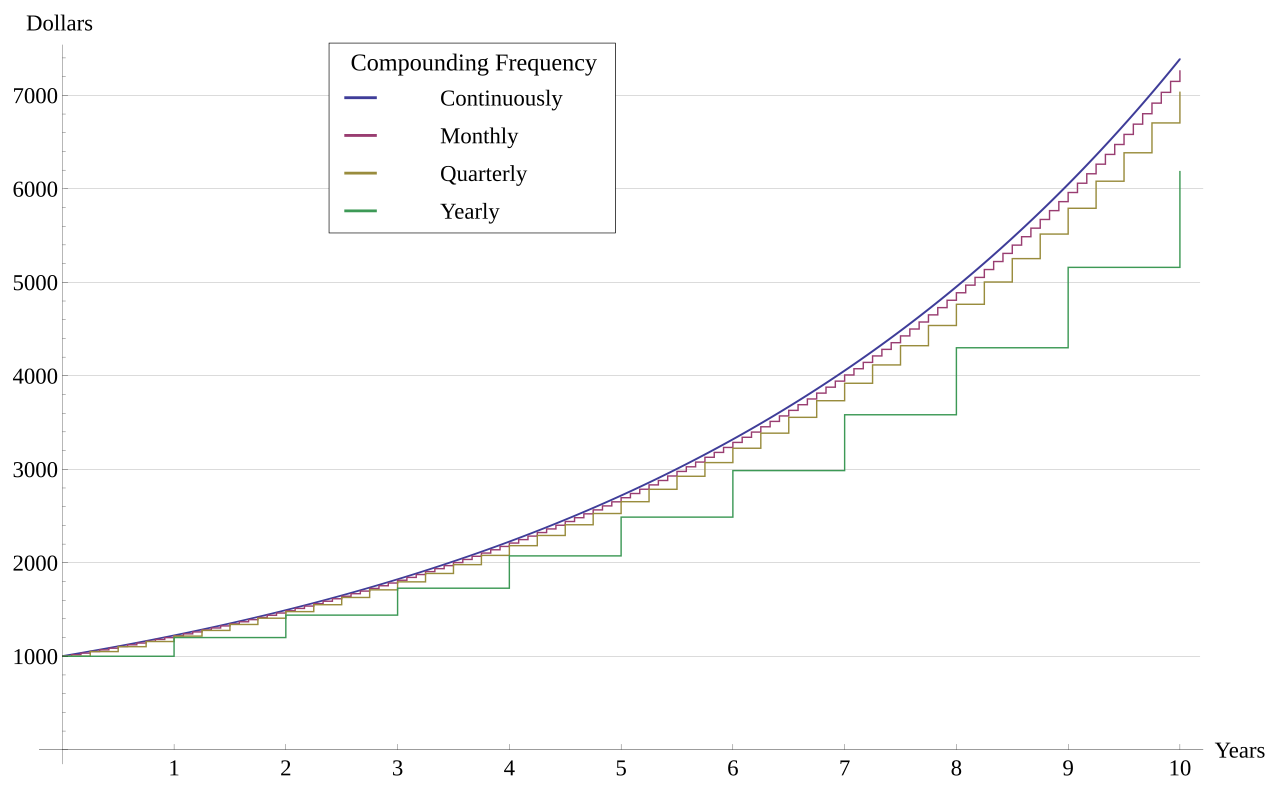
Interest on interest, known since ancient times.

Unknown author Unknown author or not provided · Public domain
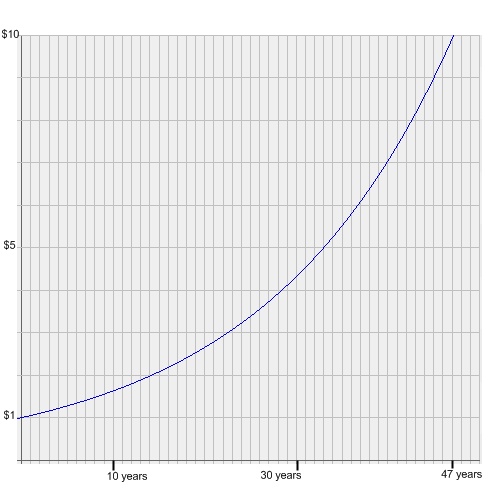
Compound interest is interest accumulated from a principal sum and previously accumulated interest. It is the result of reinvesting or retaining interest that would otherwise be paid out, or of the accumulation of debts from a borrower. Compound interest is contrasted with simple interest, where previously accumulated interest is not added to the principal amount of the current period.
- known_for
- Compound interest calculation and analysis
- field
- Mathematics, finance
- first_traces
- Clay tablet from Babylon, about 2000–1700 B.C.
- early_table
- Francesco Balducci Pegolotti, Pratica della mercatura, about 1340
- rule_of_72
- Luca Pacioli, Summa de arithmetica, 1494
- landmark_book
- Richard Witt, Arithmeticall Questions, 1613
- constant_e
- Jacob Bernoulli, 1683
Lore & Background
Richard Witt's book Arithmeticall Questions, published in 1613, was a landmark in the history of compound interest. It was wholly devoted to the subject (previously called anatocism), whereas previous writers had usually treated compound interest briefly in just one chapter in a mathematical textbook. Jacob Bernoulli discovered the constant e in 1683 by studying a question about compound interest.
Reader's Guide
Compound interest is a foundational concept in modern finance, enabling the growth of investments and the accumulation of debt over time. Its mathematical formulation, involving periodic or continuous compounding, underpins the valuation of loans, bonds, and derivatives. The annual equivalent rate (AER) and similar measures help consumers compare financial products by standardizing the disclosed interest rate to an annualized compound basis, often including charges other than interest. Historically, compound interest was condemned as usury under Roman law and other legal systems, but its practical utility led to its gradual acceptance and formal study. The work of medieval and Renaissance mathematicians, from Babylonian tablets to Pegolotti's tables and Pacioli's Rule of 72, provided early tools for calculation. Richard Witt's 1613 treatise marked the first book entirely devoted to compound interest, while Jacob Bernoulli's 1683 investigation of continuous compounding led to the discovery of the mathematical constant e. Today, compound interest is essential for personal finance, corporate finance, and economic modeling, with applications ranging from mortgage amortization (where U.S. mortgages use an amortizing loan, not compound interest) to the continuous compounding used in derivative pricing via Itô calculus.
Did You Know?
- A clay tablet from Babylon, dating from about 2000–1700 B.C., might be the first display of the compound interest problem.
- The Florentine merchant Francesco Balducci Pegolotti provided a table of compound interest in his book Pratica della mercatura of about 1340.
- Jacob Bernoulli discovered the constant e in 1683 by studying a question about compound interest.
- U.S. mortgages use an amortizing loan, not compound interest, with an amortization schedule used to determine how to apply payments toward principal and interest.
What Compound Interest Actually Is
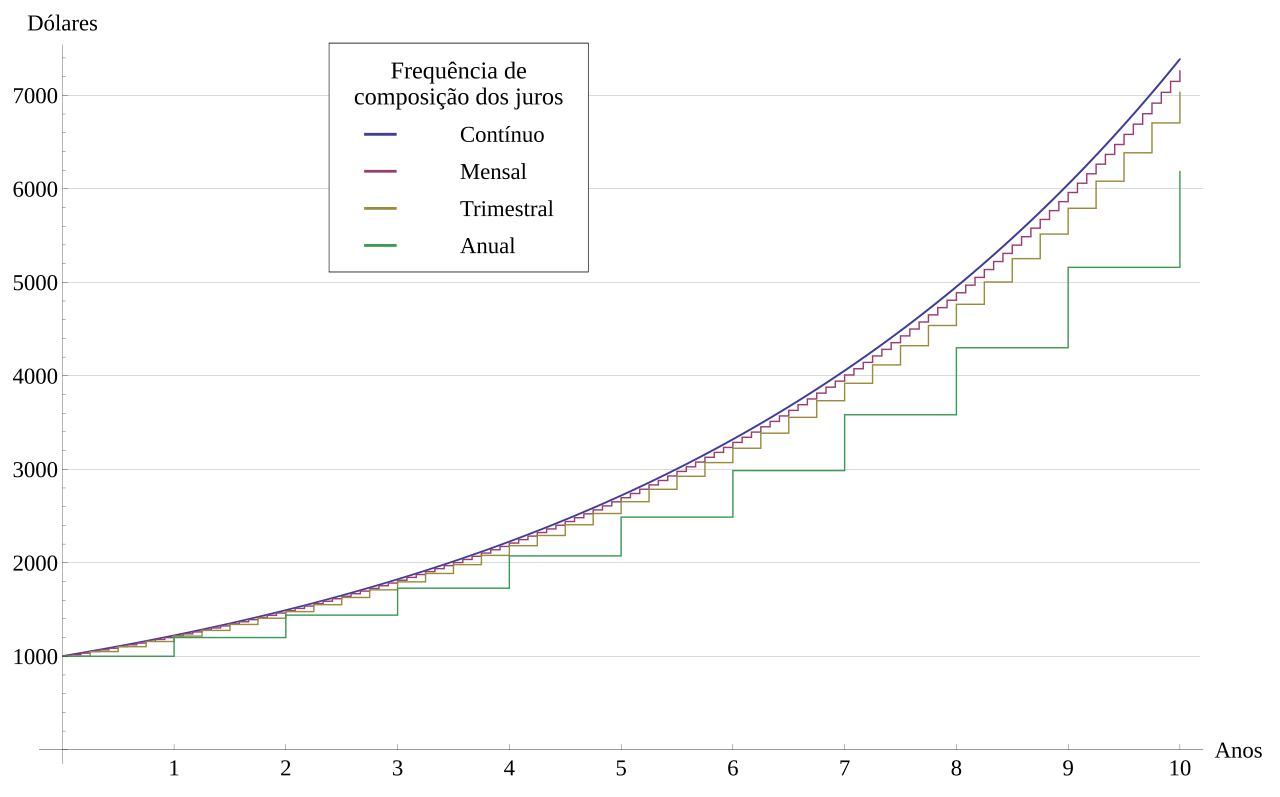
In financial and economic terms, interest represents the extra amount a debtor pays back to a lender beyond the original principal sum, calculated at a predetermined rate. This is fundamentally different from a fee, which might be paid to a third party, and from a dividend, which a company distributes to shareholders on a pro-rata basis from profits rather than at a fixed rate. It also differs from profit itself: interest belongs to the lender, while profit accrues to the owner of an asset or enterprise, even though interest may constitute part of an investment's total return. Compound interest takes this concept a step further. Rather than earning returns only on the original principal, the borrower or saver also accrues interest on previously accumulated interest. This recursive mechanism causes the total debt or balance to grow exponentially over time. The interest rate itself is simply the amount of interest paid or received over a given period divided by the principal, typically expressed as a percentage. In everyday practice, compounding is applied on a daily, monthly, or yearly schedule, and the frequency at which interest is compounded has a substantial effect on the final outcome.
Roots in the Ancient World
Credit relationships appear to have existed long before the invention of coinage, stretching back thousands of years. Among the earliest documented evidence are Sumerian records dating to approximately 3000 BC, which reveal a systematic practice of lending grain and metals. While the precise origin of interest as a formal concept remains uncertain, its presence in Sumerian records suggests it was already well established by that era. Historians speculate that the modern notion of interest may have evolved from the leasing of animals or seeds for productive agricultural purposes, since both could reproduce themselves and thus justify an additional charge. The first written evidence specifically of compound interest dates to roughly 2400 BC, with an annual rate of approximately 20 percent. This mechanism was not merely a financial curiosity; it played a crucial role in the development of agriculture and was instrumental in the process of urbanization. In the early second millennium BC, the Laws of Eshnunna established a legal interest rate, notably applied to deposits of dowry, reflecting a society where silver used in exchange for livestock or grain could not multiply on its own. These ancient practices laid the groundwork for centuries of evolving financial thought.
Moral and Religious Resistance
Throughout history, the charging of interest has provoked moral and religious opposition across civilizations. Ancient Jewish tradition, rooted in a pastoral and tribal worldview, included a prohibition against usury known as NeSheKh, a different perspective from the urbanized Middle Eastern societies where interest was accepted. In the Christian world, the First Council of Nicaea in 325 AD forbade clergy from engaging in usury, defined as lending above one percent per month, roughly 12.7 percent annually. By the ninth century, ecumenical councils extended this restriction to laypeople. St. Thomas Aquinas, the leading Catholic theologian of the Scholastic era, argued that charging interest constituted double charging—collecting for both the thing lent and its use. In the medieval economy, where loans arose from necessity such as crop failures or workplace fires, extracting interest was considered morally reproachable because no tangible goods were produced. Islamic civilization similarly viewed interest, known as riba, as explicitly forbidden by the Qur'an. Medieval jurists devised instruments like the Contractum trinius to navigate these restrictions. The Renaissance shifted attitudes as borrowed money increasingly funded production rather than mere consumption. In the modern era, countries including Iran, Sudan, and Pakistan have pursued interest-free Islamic banking, where lenders share risk through profit-and-loss arrangements and all transactions must be asset-backed.
The Mathematical Legacy
The study of compound interest left a lasting mark on mathematics. It is thought that Jacob Bernoulli discovered the mathematical constant e while investigating a seemingly straightforward question about compound interest. He considered an account beginning with one dollar that earns 100 percent interest per year. At the end of the year, the balance doubles to two dollars. But if the interest is computed and added twice during the year, the initial dollar is multiplied by 1.5 on each occasion, yielding 1.00 × 1.5² = 2.25. Bernoulli observed that as the frequency of compounding increases without limit, the resulting sequence converges toward a specific value, which he modeled using a limit expression. This insight, born from the practical mechanics of how interest accumulates on prior interest, ultimately led to the identification of e, one of the most fundamental constants in mathematics. The exponential growth that compounding produces is not merely an abstract curiosity. In practice, the choice between daily, monthly, or yearly compounding schedules greatly alters the final amount owed or earned, making the compounding rate a powerful determinant of financial outcomes. The mathematical study of this phenomenon thus bridges the gap between everyday banking and deep mathematical structures.
Gallery

Frequently Asked Questions
Who is Compound interest?
Compound interest is a financial mechanism in which the interest earned in one period is added back to the original principal, so that every subsequent period generates interest on both the initial sum and all previously accumulated interest. It stands in direct contrast to simple interest, where prior interest is paid out rather than reinvested.
What are Compound interest's powers/role?
Its core power is exponential growth: by continuously reinvesting or retaining earned interest, the balance grows faster over time than a linear (simple-interest) model would allow. This same mechanic works in reverse for borrowers, letting unpaid interest roll into the principal and accelerate debt accumulation.
How does Compound interest's story end?
It has no true ending—it is a perpetual process that continues for as long as interest is retained in the account or rolled into the loan balance. In practice, the 'story' concludes when the account matures, the loan is repaid, or the holder simply stops reinvesting and switches to simple-interest payouts.
Why is Compound interest important?
It is the mathematical engine behind savings accounts, bonds, mortgages, retirement funds, and virtually every long-term investment product, making it central to both personal finance and macroeconomic modeling. The famous Rule of 72, first recorded by Luca Pacioli in 1494, is a quick shortcut fans use to estimate how fast a balance doubles under compounding.
When did Compound interest first appear?
The earliest known traces are on Babylonian clay tablets dating to roughly 2000–1700 B.C., showing that the idea of interest-on-interest is thousands of years old. A more formal written treatment appeared in Francesco Balducci Pegolotti's 1340 mercantile manual, and Richard Witt's 1613 arithmetic text is often cited as a landmark in English-language compound-interest calculation.
More in Economic Concepts & Models 1-24
Elsewhere in the Economic Concepts & Models universe
Spotted an error? Know more?
This is a living reference — every entry is fact-audited, and reader corrections feed straight into our audit queue. Suggest an edit · See this site's audit record